
“Casting all your cares [all your anxieties, all your worries, and all your concerns, once and for all] on Him, for He cares about you [with deepest affection, and watches over you very carefully].” —1 Peter 5:7 AMP
When They Won’t Tell You Why
What I’m about to talk about is not easy. And I’m definitely not writing this like I got it all figured out and peace just showed up on command. I’m writing this because I’ve had to choose it — over and over, sometimes in the same hour — and some days ‘the choosing’ is harder than others.
Someone decided to cut you out of their life. It could be a parent and their child, or two friends who’ve known each other for twenty-plus years. There’s no conversation, no closure, just complete silence where an explanation should be.
So what do you do? You ruminate on it — replay every conversation, reread and rewrite every text, build out a dozen theories for what you might have done? Or do you just let it go?
I used to think those were the only two options. But there’s a third one, and it’s the best one: give it to God, and then rest in that — not because the hurt isn’t real, but because you’ve finally accepted the one thing rumination can never give you. You can’t control what another person does. You can only control yourself.
That sounds simple, but living in it is not.
What Rumination Actually Is
Rumination isn’t just “thinking about something a lot.” It’s thinking about something on a loop by replaying the same scene, the same conversation, the same unanswered question, over and over, without ever arriving anywhere new. Sometimes you might even make up scenarios to add to the loop.
The word rumination actually comes from the way cattle chew their food. You know, they swallow it, bring it back up, chew it again, and swallow it again. When the mind ruminates, it does something similar—but without the useful result. You keep bringing the same thing back up, yet you never fully digest it or move forward.
That’s what your mind does when someone cuts you out of their life and won’t tell you why. You don’t just think about it once and move on. You chew on it. You bring it back up in the shower, in traffic, at 2:30 a.m. Perhaps it’s not even a relationship; maybe it’s the job you didn’t get, replaying the interview for the hundredth time trying to find the moment it went wrong. Or maybe it’s something you said in a meeting that probably landed fine, but you’re still picking it apart hours later. Either way, you chew it again. And each time, you’re hoping this pass will finally digest it or finally make sense of it. But it doesn’t; it just keeps you circling in the same spot.
That’s the difference between thinking something through and ruminating on it. Thinking moves toward an answer or a decision, but rumination just moves around and around — in circles.
Rumination Feels Like Diligence. It Isn’t.
Rumination plays a trick on you because it doesn’t always feel like torture while you’re doing it. Sometimes, it feels like work— like you’re being thorough and responsible. It feels like if you think hard enough, long enough, and from enough angles, you’ll find the answer. And then, finally, you’ll be able to rest.
But that’s the lie. Rumination promises rest as a reward for enough analysis. However, rest doesn’t work that way. Rest isn’t something you earn by solving the mystery. It’s something you choose while the mystery remains unsolved.
That’s the real dilemma, isn’t it? Rumination or rest.
Rumination says, “I’ll figure this out myself. I’ll keep thinking it over until it makes sense to me. I’ll find the answer.”
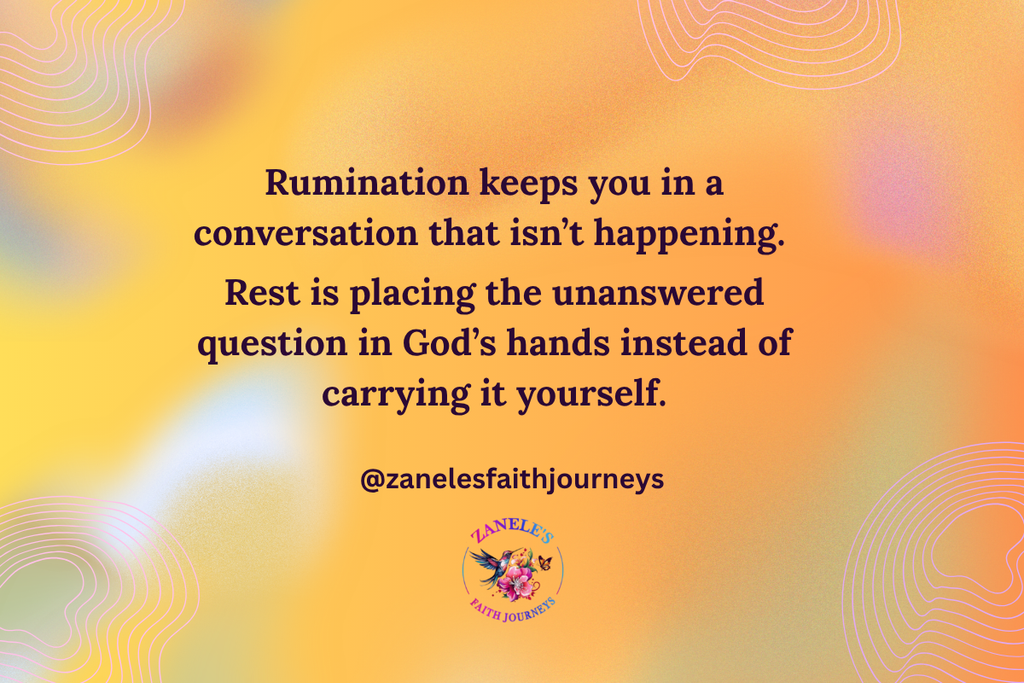
Rest says, “I don’t have to know. I can’t control what they do or don’t tell me. However, I can control what I do with the not-knowing. I can hand it to God instead of carrying it myself.”
Rumination keeps you in a conversation that isn’t happening. Rest lets you step out of it.
Choosing rest in a moment doesn’t mean the urge to ruminate disappears. You can choose to let it rest on Monday and still find yourself back in the spiral on Wednesday at 2:30 a.m., rereading those old texts, rehearsing conversations that’ll never happen. Don’t think of that as failure. That’s just the process of unlearning a habit your mind has practiced for years.
Not Taking It Personally Doesn’t Mean It Didn’t Hurt
Somewhere along the way, “don’t take it personally” got turned into a way of saying “don’t feel anything about it.” That’s not what it means, and if that’s how you’ve been hearing it, let me tell you right now that’s not it.
Not taking something personally isn’t about numbing yourself to it. It’s about refusing to let someone else’s silence write the story of who you are. When they won’t tell you why, it’s tempting to fill in the blank yourself — I must have done something. I must not have been enough. I must be the problem. That’s you taking it personally. That’s you deciding their unexplained decision is a verdict on your worth.
But the truth is, their silence only gives you information about their willingness or ability to communicate with you. It does not tell you why they made their decision, and it is not a verdict on your worth. It’s not about you. And maybe you did do something. Maybe there is a real reason, and it’s fair, and you’d own it in a heartbeat if you knew what it was. But unless they tell you, that’s not information — it’s a guess. And you can’t repair, apologize for, or grow from a guess. So whether the reason is about them or about something you actually did, the outcome is the same: without them telling you, there’s nothing left for you to do—only something for you to release.
Not taking it personally does not mean it doesn’t hurt. Sometimes the pain is excruciating. You can refuse to treat someone’s silence as a verdict on your worth and still lie awake missing them. Both things can be true at the same time. Rest isn’t the absence of pain; it’s refusing to let the pain turn into a story you can’t let go of. And when you say you trust God, this is where that trust must become a choice: let it go, give it to Him, and trust Him with it.

So What Do You Actually Do?
You stop chewing. You put the question down, not because you’ve solved it, but because you’ve accepted that you can’t solve what someone else refuses to explain. You give it to God, in the plainest sense of that phrase: you let go and let God. You leave it in His hands, and when you realize you’ve picked it up again, you give it right back.
That doesn’t mean the ache disappears overnight. Choosing to leave it with God while it still hurts—that’s what trust looks like when it’s actually being tested, not just talked about.
Remember you can’t control what others do. You can’t make them explain. You can’t force closure that someone else isn’t willing to give you. But you can control whether you spend your days circling a question with no answer, or whether you release it to the One who already knows the whole story — theirs and yours.
Life is a faith journey. And sometimes walking boldly doesn’t look like moving forward. It looks like finally putting something down.
💜 Be honest about how hard it is to let go, even when you know it’s the right thing to do.
💜 Be willing to release the question you can’t answer, instead of chewing on it until it wears you down.
💜 Be trusting enough to hand the silence to God, even when He doesn’t give you the explanation you were hoping for.
If you’re in the messy middle of your own unanswered silence right now — I’d love for you to stick around. Every Wednesday, I show up here with the messy, honest parts of walking this faith journey out loud, so you don’t have to walk yours alone. Subscribe below, and let’s keep going together.
— Tami Zanele