
“Seek the Lord and His strength; seek His face continually [longing to be in His presence].” – 1 Chronicles 16:11 (AMP)
Strong Faith in Weak Seasons
When I wrote Part 1 of this series, I shared that I love Jesus but struggle with the church community. I talked about the performative culture, my exhaustion, and the way my relationship with God is thriving while my capacity for attending church is depleted.
I didn’t share that I am in the weakest season of my life right now.
Not weak in my faith—my relationship with Jesus has never been stronger. But I am depleted physically, emotionally, and mentally in ways I’ve never experienced before. And it’s in this weakness that God has been showing up most powerfully.

I’ve shared many times that transitioning through menopause has changed me in ways I never expected. It’s brought me to deep introspection about my past, memories from my childhood and adolescence, and so on. These are memories I thought I’d processed, wounds I thought had healed, patterns I never named—they’re all surfacing now, demanding to be seen, acknowledged, and dealt with.
If you’ve been following me for some time, you know one of the biggest masks menopause has stripped away is people-pleasing—something I’ve been doing since childhood. I would say yes when I meant no, show up when I wanted to stay home, and keep quiet when I should have spoken up, all to avoid judgment, to keep peace, and to be seen as “good enough.””
Menopause took that mask away. I don’t have the energy to people-please anymore. And honestly? I don’t want to.
This church hurt series is one of the many manifestations of that introspection. For years, I carried this tension silently. I told myself it was fine, that I’d moved on, that it didn’t matter. But menopause stripped away my ability to keep performing, pretending, and hiding. It helped me to get rid of the mask, or maybe it left me too tired to keep up the facade.
And so here I am, in my weakest season, finally telling one of my many truths.
When Leadership Betrays Trust
In Part 1, I mentioned that shortly after joining my church in 2000, something happened that reinforced my feeling that the church wasn’t a truly safe space. A leader in the church—someone I thought was supposed to be safe—violated that trust.
Let me tell you what actually happened.
I had just joined the church. I was excited about it—genuinely excited. I had met my pastor at Bible school in the late 1990s, and I respected his teaching. I visited his church for a while and found it to be the right church home for me.
There was a deacon who was very friendly to me. Actually, all the deacons were. So at the time, I didn’t think anything of it—he was a leader, after all. One Sunday, he asked for my phone number. I gave it to him, assuming he wanted to pray for me or check in since I was a new member. I had a young son at the time, and I thought maybe he was just being caring and supportive.

I wasn’t naive. I was trusting.
He called me one evening. We exchanged pleasantries, and then he asked, “So how are we going to do this?”
I said, “What?”
He realized immediately that he had made a mistake. He quickly said goodbye and hung up.
I was shocked. Confused. Disappointed. This was a church leader. Someone in spiritual authority. And he had just propositioned me.
That’s when my comfort level with him changed completely.
We also worked at the same workplace—a huge facility, not the same department or anything like that. But I would occasionally see him in the halls or in the cafeteria in the morning when I was picking up something to eat after my night shift. And that’s when he would try to pay for my food. Every time I saw him, I felt instant anxiety. There were times I would see him first and turn around, walking in the opposite direction.
He would leer at me—at church, at work. It was subtle, but I knew exactly how that look made me feel. Like I was a piece of meat, not a sister in Christ.
I told a friend at work what had happened, and he intervened in a way that made the deacon understand he needed to back off. And for the most part, he did.
But the damage was done. Even though he stopped, something inside me shifted.
Looking back now, I can see this clearly for what it was: predatory behavior. Harassment. At the time, I didn’t have that language for it. I just knew it made me uncomfortable. I knew it felt wrong. But I didn’t call it what it was.
What’s even more telling is that I never even considered making accusations against this church leader. It wasn’t that I weighed my options and chose to stay quiet—speaking up wasn’t even a thought. It was just yet another thing I kept to myself to deal with.
That’s what people-pleasers do. We carry things alone rather than risk making waves.
Reflection Prompt:
Experiencing hurt or inappropriate behavior from someone in a church leadership role can leave deep marks. Even if it happened years ago—or if you only noticed subtle discomfort at the time—it can shape how you feel about church, trust, or spiritual authority.
Journal Question:
Have you ever experienced behavior from someone in a church leadership role—or any spiritual authority—that made you feel uncomfortable, unsafe, or uncertain? How did it affect your trust, your faith, or the way you engaged with church, and how did you process it?
When Scripture Becomes a Weapon
When someone shares that they’re struggling with church—or simply that they don’t like attending—there’s often a predictable response they’ll hear from other Christians. It usually comes in the form of admonishment:
“The Bible says not to forsake the assembling of ourselves together.” (Hebrews 10:25)
I’ve heard it used countless times in church culture—not always directed at me personally, but often delivered as a corrective. It’s rarely offered as an invitation to conversation. More often, it’s delivered as a verdict.
And here’s the thing: they’re not wrong.

Scripture does call us to fellowship with other believers. God designed us for community—for encouragement, accountability, and bearing one another’s burdens.
But there’s a difference between using Scripture to challenge someone and using Scripture to shame them. There’s a difference between opening a door for honest conversation and slamming it shut.
When Hebrews 10:25 is used as a conversation-ender—“You need to be in church, period”—it stops dialogue. It assumes rebellion instead of pain. It prioritizes attendance over understanding.
That’s when Scripture becomes a weapon.
Notice what isn’t being asked:
“What’s making church feel unsafe for you?”
“What happened?”
“What would need to change for you to feel comfortable attending?”
“How can I, as your church family, love you better?”
Instead, they’re just telling you what you already know: you’re supposed to be there. And now you feel shame on top of the hurt you were already carrying.
Same verse. Completely different posture.
But it doesn’t have to be that way.
Imagine someone inviting you to brunch several times, and after a few times of meeting, they say this instead:
“I’ve noticed you haven’t been to church much lately. I’m wondering—what would encouragement look like for you right now? Is there something that makes it hard for you to be there? I know Hebrews talks about encouraging one another and not neglecting fellowship. Can we talk about it?”
That’s using the Word as an invitation.
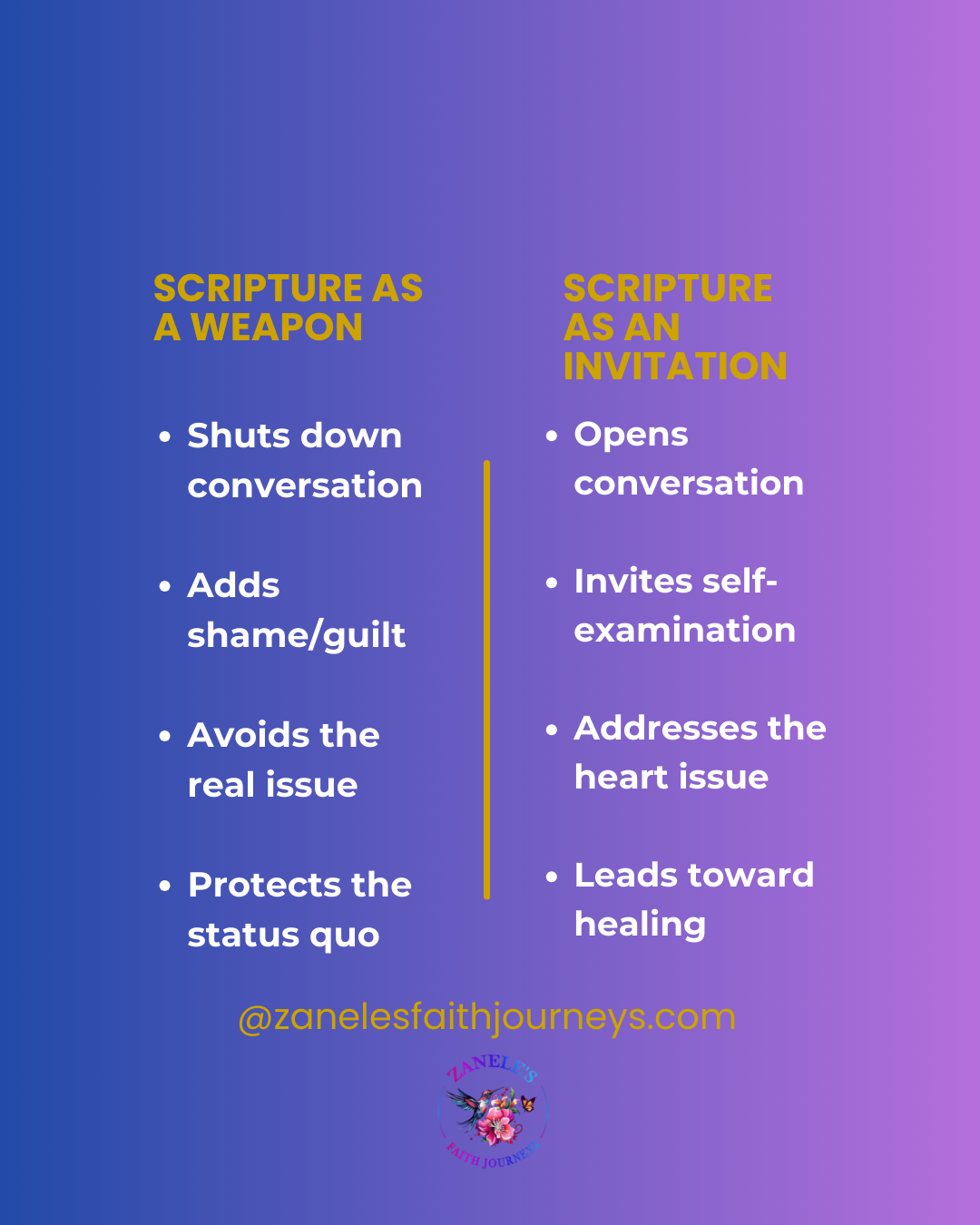
One approach shuts down communication. The other opens it up.
One adds shame. The other offers connection. One enforces compliance. The other cares for the person.
We, as followers of Jesus, should challenge one another. We should reference Scripture when we see each other drifting. But heart posture matters. Scripture was given to transform us—not to silence us. It should never be used to shame or shut down opportunities for honest dialogue about what someone is struggling with.
It’s delicate. But when done with humility and compassion, it can lead to stronger connections within the church family instead of driving people further away.
Part of why Scripture gets weaponized is the “religiosity” that has always been a part of the church culture—performance over genuine fellowship, checking boxes over authentic connection. And honestly? I think patriarchal systems play a role, too. When power is concentrated and certain voices are minimized, Scripture can become a tool to maintain the system rather than shepherd the people.
When power is concentrated and certain voices are minimized, Scripture can become a tool to preserve structure rather than shepherd souls.
There’s more to unpack here—the tension between confronting unhealthy systems while still preaching the Word of God faithfully and without compromise. But that’s a conversation for another blog post.
Journal Question: Have you experienced Scripture being used as a weapon or as an invitation? What was the difference?
The Cumulative Weight
The deacon incident didn’t happen in a vacuum. It landed on top of a lifetime of uncomfortable encounters with boys and men that had already trained me to question their motives.
As a girl, I carried a quiet wariness in my friendships with boys and men: Could I trust them, or did they have other motives? I assumed men in church leadership would be different—that their spiritual authority made them safe.
I was naïve.

That incident confirmed fears I had been trying to silence. And it didn’t just affect how I viewed him—it reinforced a guardedness I had been fighting for years. I became more cautious. More watchful. Less willing to assume good intentions.
That’s the cumulative weight.
Here’s the irony: the church should feel like a refuge. A place where people carrying shame—and there are so many of us carrying it for so many reasons—can exhale. It’s a place where healing is possible.
The church is made up of flawed people, and I mean, Every. Single. One. Of. Us.
And that is precisely why grace and mercy should govern us.
God extends us grace constantly. Generously. Without keeping score. In light of that, how dare we withhold it from one another? How can we receive mercy daily and then ration it out to others?
Yet we do.
We weaponize Scripture without recognizing it.
We add shame where hope is needed.
We protect systems instead of people.
Most of the time, it isn’t malicious. It’s unexamined. It requires humility to pause and ask hard questions:
Am I using Scripture to shepherd this person toward healing—or to shut them down?
Am I opening a door for honest dialogue—or quietly slamming it closed?
Am I defending truth—or defending my comfort?
God’s Faithfulness in My Weakness
As I write this, I’m sitting in the reality of what I said at the beginning: this is the weakest and most difficult season of my life—and what a gift it has been!
I’m discovering something deeper—God’s faithfulness has never depended on my strength.
“Seek the Lord and His strength; seek His face continually.” (1 Chronicles 16:11, AMP)
Right now, seeking Him looks like surrender. It looks like admitting I’m tired—and I am tired. It looks like choosing to believe that when I have nothing left to give, He still sustains.
Our God is constant. He is never absent. Never distracted. Never withholding. When I call on Him—even in exhaustion—He is there. There is no one more faithful to me than the Lord Jesus.

The church has failed me. People have failed me. I have failed others. We are flawed. Every. Single. One. Of. Us.
But Jesus? He has never failed me. Not once.
He met me at twenty-one, at what felt like the lowest point of my life. He has walked with me through betrayal, disappointment, growth, healing, and hard truth. And He is with me now—in this season of introspection and truth-telling, as menopause strips away masks I didn’t even realize I was still wearing.
I don’t have all the answers. I don’t know what my relationship with the church will look like moving forward. I don’t know whether I’ll attend regularly again or discover a different expression of fellowship that feels life-giving instead of draining.
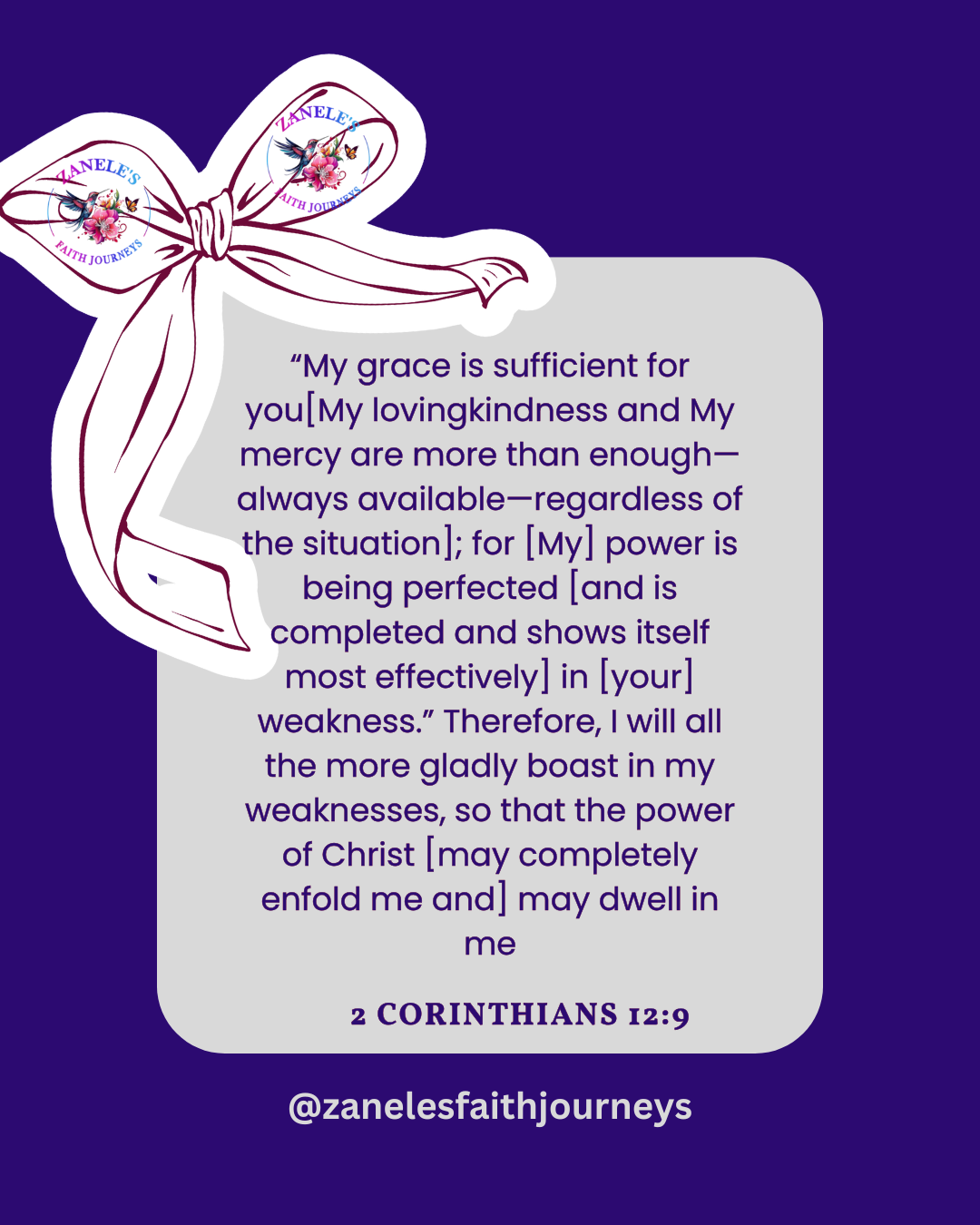
What I do know is this: I’m placing that in the Lord’s hands. I’m looking to Him for direction—praying that I hear Him clearly and have the courage to obey what He says. (2 Cor. 12:9).
My relationship with Jesus is not dependent on whether or not I attend church regularly. Those are not the same thing.
And the One who matters most? He isn’t going anywhere.
Reflection Questions
Where have you seen God’s faithfulness in your weakest moments?
What would it look like to tell one of your truths—the ones you’ve been carrying silently?
How do you discern the difference between healthy challenge and harmful weaponization when Scripture is used?
If this resonated with you, share it with someone who needs to know they’re not alone in their church hurt.
Life is a faith journey. Walk boldly—even when you feel weak.
Be brave enough to tell the truth. 💜
Be faithful enough to trust the process. 💜
Be kind enough to extend grace—to others and to yourself. 💜