
‘

When Pushing Through Stopped Working
It was the summer of 2023, and I had just turned 53. If you had asked me to describe how I felt, I would have told you I felt like an egg being fried on a hot skillet. I was completely overwhelmed and sizzling under pressure, but I couldn’t quite name it. Or like my poinsettia plant I got at Christmas; it was wilting in the hot sun on my balcony, despite my best efforts to keep it together.

I was two years post-menopause, and estrogen had just about completely left the body of Tami Zanele (that’s me, lol). My mind and body were overwhelmed by it all, but I, not really understanding what was happening, was determined to push through like I always had. I had even started a master’s program in nutrition. I was so excited about it, too. I thought I was going to become a nutritionist! I wanted to learn more about nutrition and help not just myself, but thousands of women nutritionally through the changes of menopause. But within months, I was so overwhelmed that I had to quit. My body was screaming, “slow down,” but I didn’t understand the language it was speaking.
Life is a faith journey—even when that journey includes hot flashes, sleep-challenged nights, anxiousness, and dreams that suddenly feel too big for your depleted energy reserves. If you’re reading this and nodding along, feeling like your body has become a stranger you no longer recognize, I want you to know: you’re not losing your mind. Your body is simply changing, and it’s trying to tell you something important.
Fearfully and Wonderfully Made – Even Our Stress Response
David wrote in Psalm 139:14, “I praise you because I am fearfully and wonderfully made; your works are wonderful, I know that full well.” But when we’re lying wide awake in bed at 3:30 AM with heart palpitations for no apparent reason, or when anxiety hits us like a mack truck over something that wouldn’t have fazed us five years ago, it can be hard to feel wonderfully made.

Since then, I’ve learned that even our stress response, even the overwhelm that feels so frightening, is part of God’s intricate design. Our nervous system is our body’s communication network, the highway system that carries messages between our brain and every other part of our body. It helps govern everything we do, think, and feel, and it plays an essential role in our sleep, mood, digestion, energy levels, and overall sense of well-being.
Think of your nervous system as having two main sides, like a perfectly designed seesaw that God created to keep us balanced:
The Sympathetic Side: “Fight or Flight.” This is our body’s built-in alarm system, designed to protect you when danger appears. When this system activates, your heart rate increases, your breathing quickens, and stress hormones, such as cortisol, flood your system. It’s a brilliant design for escaping sudden danger or handling a true emergency. But it’s a significant problem when this system gets stuck in the “on” position.
The Parasympathetic Side: “Rest and Digest:” This is our body’s healing and restoration mode. When this system is active, your heart rate slows, your breathing deepens, your digestion works properly, and your body focuses on repair and renewal. This is where the magic of healing happens, as God designed our bodies to restore themselves.
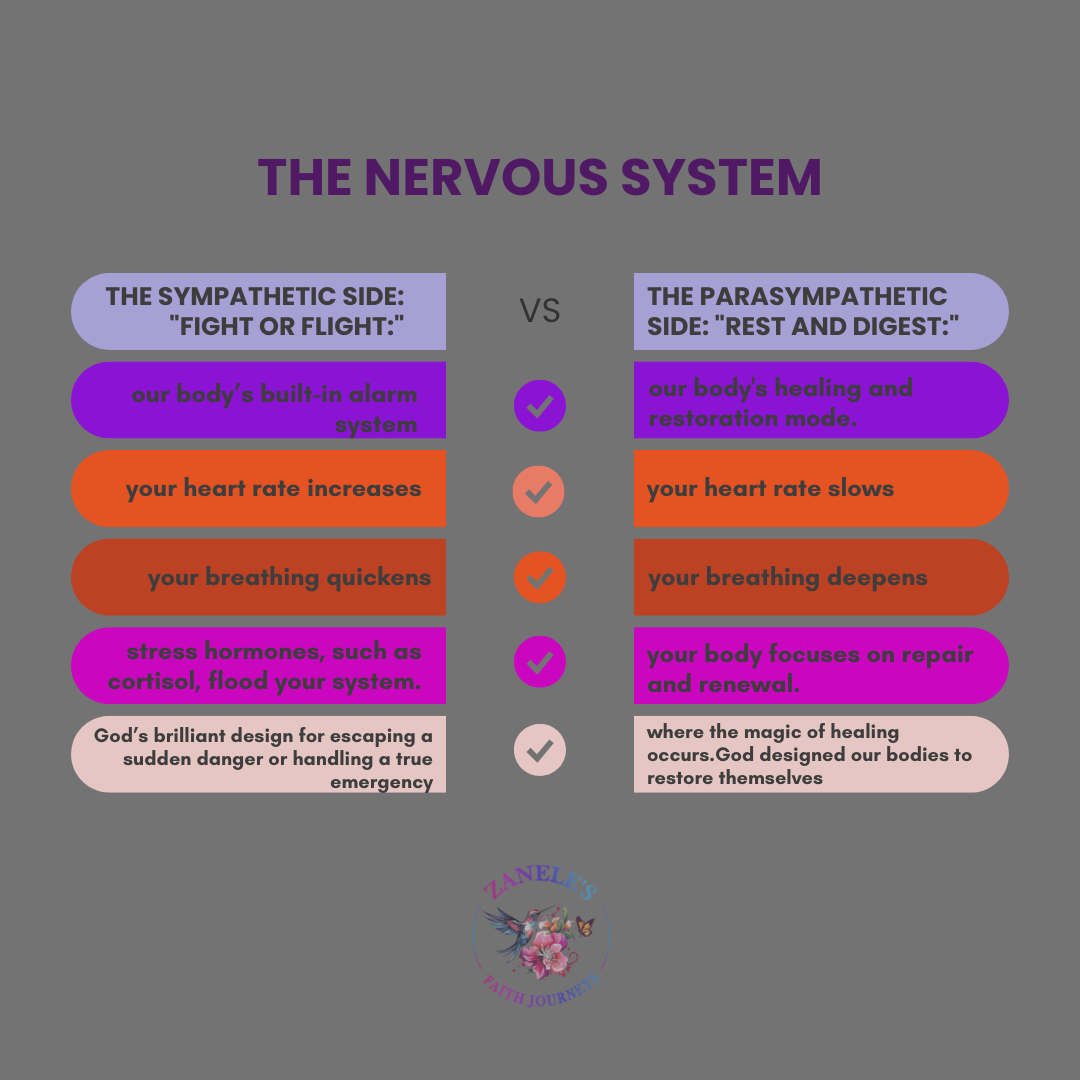
Both sides are necessary and beautiful, but here’s the key: balance is everything. And during perimenopause and menopause, that balance becomes so much harder to maintain.
When Estrogen Says Goodbye – The Ripple Effect We Didn’t See Coming
Dr. Mary Claire Haver, OB/GYN and author of “The New Menopause,” explains that estrogen isn’t just about reproduction; it’s a powerful neuroprotective hormone that helps keep our nervous system calm and regulated. When estrogen levels decline during peri-menopause and disappear almost entirely after menopause, our nervous system loses one of its most important stabilizing forces.
Here’s what’s actually happening in our bodies during this transition:
Estrogen’s Protective Role: Estrogen acts as a bodyguard for our nervous system, helping to regulate neurotransmitters such as serotonin and GABA (a naturally occurring amino acid that acts as a calming messenger in our nervous system) that help maintain a calm and balanced state. As Dr. Mindy Pelz, a functional medicine and fasting expert, notes in her research, that estrogen also helps regulate cortisol, our primary stress hormone. When estrogen declines, our stress response system becomes very sensitive.
The Sleep Disruption Connection: Progesterone, often referred to as our “calming hormone,” also decreases during this transition. Nurse Practitioner Cynthia Thurlow, an expert in women’s hormonal health, explains that progesterone has a sedating effect on the brain. When we lose it, falling asleep and staying asleep becomes exponentially more difficult. Poor sleep then feeds back into nervous system dysregulation, creating a cycle that can feel impossible to break. That’s why we as women often feel overwhelmed, cranky, and tired during perimenopause.
The Anxiety That Comes from Nowhere: You know that overwhelming anxiety that seems to appear out of thin air? The worry that feels so much bigger than the situation often warrants? That’s not another character flaw; it’s our nervous system without its hormonal stabilizers. Smaller and smaller stressors are triggering our fight-or-flight response because our bodies no longer have the same chemical buffers they once relied on to manage stress.
The Domino Effect: Here’s how it cascades: Hormonal changes affect our nervous system, which in turn affects our sleep, which impacts our mood, which influences our energy, which ultimately affects our ability to handle stress, which can then impact our hormones. It’s a complex web of interconnected systems, and when one piece shifts, everything else feels the impact. That’s a lot, ain’t it?
So, the woman who could once handle a demanding job, needy children, aging parents, and a busy household with grace suddenly feels overwhelmed by a trip to the grocery store. It’s not because we’ve become weak—it’s because our body’s entire operating system is recalibrating. In short, we didn’t know how great estrogen was until it was gone!
Trusting God Through the Change
I know just looking at this “sciencey” information can have you feeling confused and discouraged. Maybe you’re thinking, “Great, so this is how it’s going to be now?” But I want to share a different perspective with you.
God’s design for our lives include seasons of transition. Just as He created spring to follow winter, and dawn to follow the darkest hour of night, He has designed our bodies to move through seasons of change. The Bible reminds us in Ecclesiastes 3:1, “To every thing there is a season, and a time to every purpose under heaven.”
This season of hormonal transition isn’t a punishment; it’s really an invitation. An invitation to slow down, to listen more carefully to what our bodies need, and to discover new ways of caring for the temple God has given us. It’s an invitation to practice deeper self-compassion and to embrace the wisdom that comes with age. It’s an invitation to experience God in a new way.
We don’t have to walk through this alone. God is with us in every hot flash, every sleep-challenged night, every moment when anxiety tries to convince us that something is terribly wrong. He knows our frame, He remembers that we are dust (Psalm 103:14), and He loves us completely—not despite of our changing bodies, but including them.
We’re in this together, sis. Every woman who has walked this path before us, every woman walking it alongside us, and every woman who will walk it after us. There’s no shame in struggling with changes that are completely natural and normal. In the past, women didn’t talk about these things. Thank God that we are the generation that decided to speak up. There’s grace, community, and the promise that understanding is the first step toward healing.
Your Best Years Are Still Unfolding
Here’s what I want you to take away from our time together today: Your anxiety isn’t a character flaw. It’s your nervous system’s way of asking for help. You’re not losing your mind ( I honestly thought I was). It’s your body changing. And most importantly, understanding these things is the first step towards healing.
Next week, we will explore God’s toolkit for nervous system healing. We’ll dive into the practical, science-backed ways He has equipped us to support our changing bodies through movement, grounding, rest, and community. We’ll discover that He hasn’t left us to figure it out on our own during this transition. He’s given us everything we need not to just survive this season, but to thrive in it. He’s also blessed us with brilliant doctors and scientists who know how to help us navigate the changes menopause will bring.
Until then, I want you to practice one simple thing: when you feel that anxiety rise, when your nervous system starts to feel overwhelmed, place your hand on your heart and remind yourself, “I am fearfully and wonderfully made. My body is doing the best it can, and God walks with me through every change.” Hallelujah!! (Understanding that God is always faithful gives me reason to shout).
More Help for Your Journey
The experts I mentioned today – Dr. Mary Claire Haver, Dr. Mindy Pelz, and Nurse Practitioner Cynthia Thurlow – all have great podcasts that dive much deeper into these topics. I highly recommend them! Their shows are packed with practical wisdom, encouragement, and science-backed facts specifically for women navigating perimenopause and menopause. Give them a listen when you need extra support and guidance on this journey. Sometimes it helps to hear different perspectives speaking truth into the changes we’re experiencing.
Please know that your best years aren’t behind you; they’re still unfolding. (I have to remind myself of this all the time!) And next week, we’ll explore exactly how to step into them with confidence, armed with practical tools and unwavering faith.

Before you go, grab your journal and spend a few minutes with this prompt: What would I say to my best friend if she told me she was struggling with the same overwhelm I’m experiencing? How can I extend that same kindness to myself today?
Life is a faith journey. Walk boldly—even through even through perimenopause, menopause, and post-menopause. The Lord is there with us through it all.
Be brave enough to pursue your dreams. Be faithful enough to trust the process. Be kind enough to help another woman along the way.💜