
Letting Go of What I Can’t Control: A Journey of Faith and Peace
I am a huge fan of Mel Robbins, and one day, while I was listening to her podcast, she referenced her best-selling book, The Let Them Theory. This excellent book is one of many resources that help remind me of my power and, to not let the things I can’t control govern how I react.
Her book isn’t about faith specifically, but it’s packed with practical wisdom that aligns beautifully with what I believe God teaches us about letting go of what’s not ours to carry. Her book encourages us to let people do whatever they’re going to do, but to let me (or you) focus on what I (or you) can do and how I (or you) choose to respond.
It got me thinking about a particular kind of heartbreak that doesn’t just come from strangers, but from the people you love the most, the ones you care about deeply.

I thought about when some of my high school friends attended an alumnae event a few years ago. I only learned about it because another friend told me she was invited and assumed I was, too.
For a moment, I wondered—Why didn’t they ask me?
Did they just forget? Or did they leave me out on purpose? Then I ruminated some more about why no one asked me.
And truthfully? I don’t believe it was an oversight. That realization? It stung a bit.
But although my feelings were hurt, I wasn’t angry.
I quickly (and surprisingly) accepted that I wasn’t supposed to be at that event with them.
Mel Robbins’ The Let Them Theory reminded me of something I wish I’d understood a long time ago:
People are going to do what they do. Let them.
Let them gather without you.
Then let me not obsess about it, not hold a grudge about it. Let me understand—it’s not my job to twist myself into knots trying to understand behavior that wasn’t meant for me to carry.
And as a woman of faith, I’ve learned this truth in a deeper way:
God never overlooks me, even when people do.
Psalm 118:6 (AMP) says, “The Lord is on my side; I will not fear. What can [mere] man do to me?”
That verse reminds me that human rejection can’t cancel divine protection. I don’t have to overthink what others are doing—or not doing—because my identity isn’t rooted in their approval.
The Wedding: When Letting Go Feels Like a Process
And then there was my wedding in 2013.
A time that should’ve been full of love, joy, and genuine celebration. And for the most part, it was.
But I also saw the ugly side.
I remember calling a good friend to tell her I was getting married. She went completely silent. I was like, “Hello?”—no congratulations, no joy—just awkward silence. We spoke for a few minutes and hung up. A few minutes later, she called back, sounding more excited, but the damage was already done.
Another friend asked why I had waited so long to tell her. But the truth is, I hadn’t. I wanted to share the news with my immediate family first, and she was actually the first friend I told.
Unfortunately, some of the people I expected to be the happiest for me weren’t. But then again, some who surprised me with their genuine joy completely lifted my heart—and those are the moments I held on to.
A few friends and family members talked about me behind my back—and not kindly.
They criticized the timing (a Friday evening), the size (small and intimate), and the fact that we made it an adult-only wedding. There were no random plus ones unless we knew about a committed relationship. It wasn’t to exclude but to create something personal and sacred. We would’ve made exceptions if asked, but they chose to gossip instead of asking.
And yes—it hurt. Deeply.
It left me asking the question we all wrestle with when people we care about let us down:
Why? Why would they do that?
I was practicing the Let Them Theory before it had a name.
Our wedding. Our choices.
So I had to let them.
Let them talk.
Let them misunderstand.
Let them sit with whatever made them choose to act that way.

And…
Let me not carry what’s not mine.
Let me keep showing up in love.
Let me trust God to handle the battles I’ll never even see.
“The Lord will accomplish that which concerns me…” – Psalm 138:8 (AMP)
That verse reminds me that God is in charge of my story, not them. He’s writing my chapters. He’s ordering my steps.
But I’ll tell you the truth—I was “letting them” on the outside, but inside? I was still holding on.
I was still carrying the sting of their silence.
Still wondering if I did something wrong.
Still worrying too much about what they thought.
Letting go doesn’t always happen in one clean moment. Sometimes it’s a process—one prayer, one hard truth, one deep breath at a time.
Most of the time, it’s not about you.
It’s about them.
Their wounds.
Their disappointments.
Their inability to celebrate someone else’s joy.
That’s when I had to surrender the need to be understood to Jesus, the One who understood me completely.
God sees what I can’t. He knows what they don’t. And He never misses a moment to defend, heal, and restore.
Have you ever had to “let them” in a situation that really hurt?
Take a moment to reflect:
- What was the circumstance?
- What did you feel?
- What did you learn about yourself—and God?
Please take a moment to reflect on these takeaways in your own life. Grab your journal and jot down how you’re learning to let go and embrace the peace of trusting God. Or, if you feel led, share your thoughts in the comments below. Let’s walk this journey together, supporting one another as we grow in faith and freedom.

When the Ones We Love Don’t Get It
Here’s the truth I’m still working through: I have a real problem with worrying about what people say about me behind my back, especially when it’s people I love.
Family. Close friends. Folks who’ve seen me through every season.
When I quit my job last year without having the next one lined up, I knew there were whispers.
And when I married a man 15 years older than me, almost 12 years ago? Oh, the comments.
They weren’t always loud or obvious—just little digs—subtle jabs.
But for some in my family, the shade doesn’t come as open disapproval—it comes dressed up as a joke.
They tolerate him. They’re polite. But even after 12 years, some of my closest family still haven’t fully welcomed him.
And you know what? That kind of half-acceptance wears on you over time, especially when you notice that the energy from some just feels… off.
And while I get it—not everyone vibes with everyone—I’d be lying if I said it didn’t hurt. But that’s life.
I can’t pretend it doesn’t sting when some of my people treat the man I love like an outsider. That’s hard not to take personally.
And even when I tried to pretend it didn’t bother me, God kept nudging me:
“You don’t have to pretend you’re not hurting to be strong. You don’t have to carry the rejection just to keep the peace. Let Me carry it.”
So I started giving that hurt to Jesus.
I laid it at the feet of the One who sees the whole picture.
Slowly, I stopped waiting for people to catch up to what God had already approved.
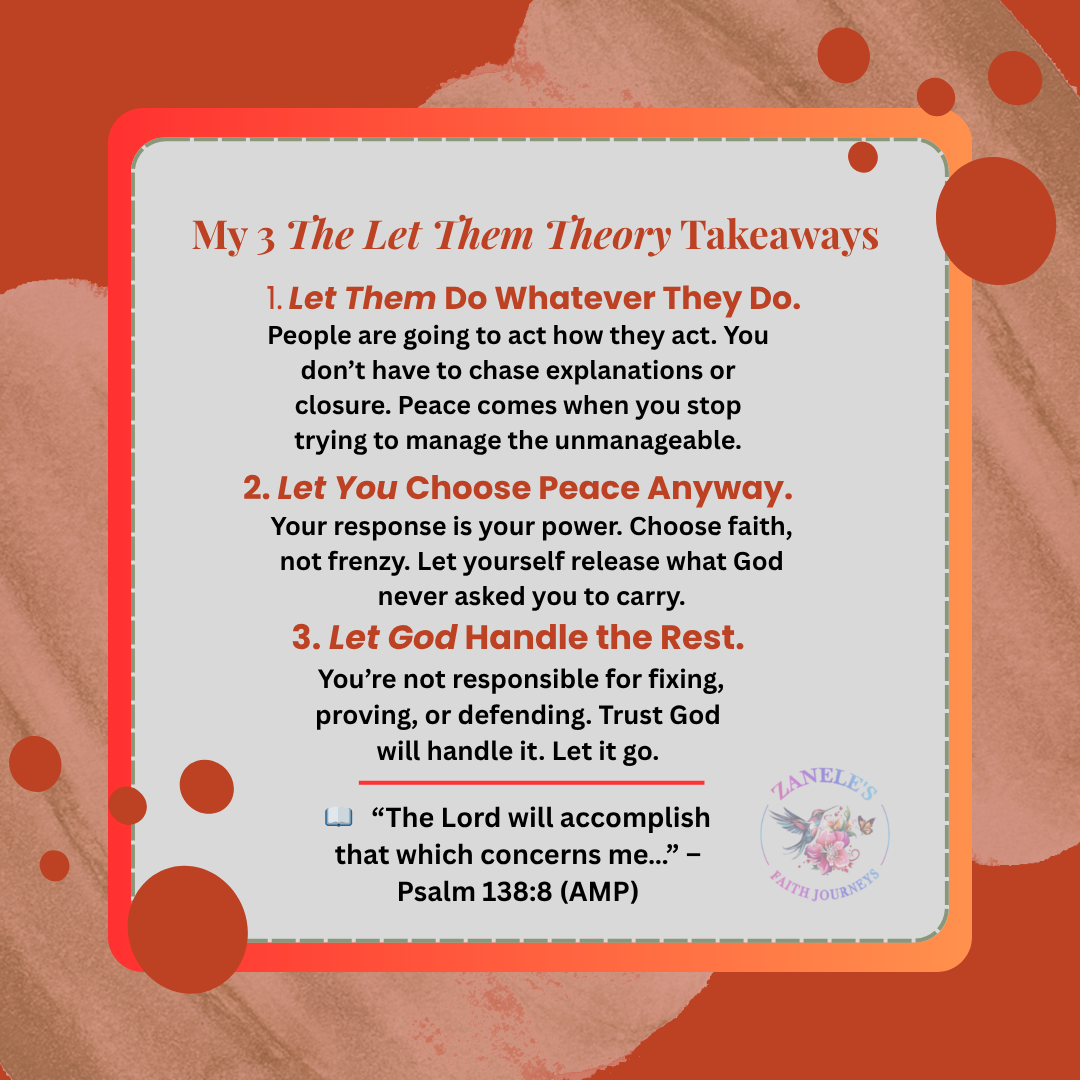
This book didn’t just help challenge my mindset—it gave me permission to stop chasing validation and start choosing peace. Here’s how it showed up in my faith walk.
Letting Go, Moving Forward
People may never fully understand the choices I’ve made. And they don’t need to because they’re my choices! They may keep talking, speculating, and making subtle comments—or keeping their distance. And that’s their right.
Let them.
Let me choose peace anyway.
Let me keep showing up in love.
Let me stop giving away my joy just to gain someone else’s approval.
Let me stay rooted in what I know: I’m loved and live this life by faith, not by consensus.
Psalm 138:8 (AMP) helps me to remember how:
“The Lord will accomplish that which concerns me…”
That includes the relationships I can’t fix.
The opinions I can’t control.
The misunderstandings I may never clear up.
So I’m learning—slowly but surely—to let them think what they’re going to think…
And let me focus and rely on God because He’s the One who carries me forward.
Because life—real everyday life—is a faith journey.

It’s time to step into peace—even when rejection stings or you’re misunderstood by the people you love most.
Mel Robbins’s The Let Them Theory reminds us that we don’t have to chase approval or explain ourselves to be at peace. Let them talk, doubt, and misunderstand. And let you stay focused on the lane God has marked out for you.
Her book explains a mindset I’ve been growing into for years. It is a powerful read if you’re navigating the pain of rejection, exclusion, or people misunderstanding your heart. I encourage you to check it out—it may help you find clarity and freedom.
I’m also encouraging you to release what isn’t yours to carry and fix your eyes on the journey ahead—the one rooted in faith, not consensus.
🟣 Join the conversation. Share your story in the comments below—how are you learning to let go and walk by faith, even when the whispers get loud?
I’d love to hear from you. Drop a comment or reach out—I read every message. You’re not walking this journey alone.
Always remember, life is a faith journey.
P.S. The idea behind the Let Them Theory was first introduced by Mel Robbins in her book by the same name. While her approach is rooted in personal development, I couldn’t help but see the spiritual truth woven throughout. God has been teaching me to “let them” long before I had the language for it—and Mel’s words helped connect the dots. If you’re navigating rejection, criticism, or the ache of being misunderstood, her book might bless you, too. Remember: we don’t let go alone—we let go with God.