“Search me, O God, and know my heart; test me and know my anxious thoughts. Point out anything in me that offends you, and lead me along the path of everlasting life.” – Psalm 139:23-24 (NLT)
Being Honest About Where I Am
I love Jesus. My relationship with Him is real—deeper than it’s ever been. He found me at 21, at the lowest point of my life (up until that point), and He’s been faithful ever since. He is the best thing that’s happened to me, and I cherish my relationship with the Lord more than anything or anyone.
But if I’m honest? And I am! I don’t love attending church. And I’m not afraid to say that.
This isn’t a topic you hear discussed much in Christian circles. If you dare to name this tension out loud, people will most likely label you as “not holy enough,” “backslidden,” or “letting the enemy win.” So most of us choose to stay silent. We keep showing up (or quietly stop showing up), but we don’t NAME the struggle.
I’m naming it because I know I’m not the only one who feels this way.

Why Does Church Feel Like Obligation Instead of Joy?
That’s the question I’ve been asking myself. Why does showing up to church feel more like childhood conditioning, like something I’m “supposed” to do, rather than something I genuinely want to do? Jesus meets me in real life every day, not just in the building we call ‘church’.
Before you label me or dismiss what I’m saying, let me be clear: I’m not making excuses for disobedience. I understand that scripture calls believers to assemble and encourage one another (Hebrews 10:24-25). I know that we’re all imperfect people, myself included. I’m not saying I’m better than anyone, and I’m not blaming others to avoid accountability for myself.
But can’t the assembly of believers present itself in many different ways other than just going to church every Sunday? Can it also look different than what we’ve been accustomed to?
I’m just being honest about where I am. And I’m trying to understand why.
Journal Question: What makes attending church feel life–giving for you? What can make it feel draining?
It Wasn’t Always This Way
I didn’t like going to church as a little girl much because it was boring, but as a teenager, I liked it. It was a chance to be with my friends away from my parents. But after Jesus found me as a young adult, I became more engaged in my faith. I attended bible school for two years in the late 1990s, hungry to learn more about God and His Word. That’s where I met my pastor, and in 2000, I decided to join his church. I was excited about it. I mean, genuinely excited.
I’ve been a member of that church for 26 years now. I love my pastor—he’s a dogmatic, bible-teaching pastor, and I like and respect him deeply. There are people in that congregation I genuinely care about, people who’ve shown me real, genuine kindness and love.
But here’s the truth: I’ve never attended regularly.
For years, I told myself it was because of my work schedule. I worked 12-hour night shifts, and many of those shifts fell on weekends. That was true—it was a legitimate reason. But it was also convenient. I could hide behind that excuse without having to examine or explain the deeper reasons I wasn’t going.
Now, I’m unemployed. The work schedule excuse is gone. My husband goes to church every Sunday. And I’m still not going regularly.
So what’s really going on?

Journal Question: What makes attending church feel life-giving for you? What can make it feel draining?
The Hurt Started Early
To answer that, I need to go back and share how my relationship with church began to shift, long before I had reasons to hide behind work or excuses.
At 21, I was attending a different church semi-regularly, and I was pregnant. I remember the looks I received when I would walk through the doors—the way people’s eyes lingered just a little too long. The judgment I felt—real or perceived—does it even matter? My body registered it as unsafe. Church stopped feeling like a refuge and began feeling like a place where I had to put on a persona, perform, and prove that I was still worthy of grace.
Shortly after I joined my current church in 2000, I was deeply disappointed by a church leader—someone I assumed I could trust, someone who was supposed to be safe. I’ll share more about that in Part 2, but for now, I’ll say this: when someone you believe has spiritual authority betrays your trust, it changes how you see the entire space. The building itself begins to feel unsafe.

After that, my attendance became sporadic—maybe four or five times a year. As a result, not many people there truly know me. I remember when my husband first visited my church before we were married. He found a seat and picked up a bulletin that had been left there. The woman sitting next to him—a member of the church—snatched it right out of his hand. It’s the kind of moment that could have turned him away before he ever gave the church a real chance. But praise God, it didn’t.
I’ve also noticed something else. Some members of my church family are incredibly warm on Sunday mornings. They offer hugs, smiles, and ask how I’m doing. But if I happen to see those same people at Walmart or the mall on a Tuesday, they act like strangers. Some seem distant. Others go out of their way not to speak at all. Maybe they just don’t know who I am (not that it should matter).
I sometimes wonder if I’m being naive—or maybe too sensitive. But then I remind myself that this is also the greatest opportunity for me to extend grace. It takes spiritual maturity to respond this way, to think kindly of someone even when they treat you coldly or unkindly. Because when I run into someone from my church family on a random Tuesday, I have no idea what they’re carrying. Their distance or brusqueness is most likely not about me. And showing kindness in those moments—that’s real faith in action.
But here’s the thing, I just might need that hug, that acknowledgment, that genuine connection more on a random Tuesday than when I’m in the church lobby on Sunday.
Because Sunday is structured, Sunday is expected.
But running into each other in the grocery store—that’s real life. And that hug or acknowledgement just might make us both feel good.
And when the love shown inside the church building (feels like it) doesn’t extend beyond it, it starts to feel less like a genuine connection and more like a performance.
The Performance Problem
And that’s what it is, isn’t it? Performance.
Even though we show up at the church, the goal isn’t simply attendance or appearance—it’s worshipping Jesus together as a family. Yet sometimes, the love and connection we display inside the building doesn’t carry outside, and we’re reminded that much of what we show at church is just that—a performance. Christians—myself included—often show up inauthentically. We perform holiness instead of living it. We project a persona instead of being real. We’re afraid to share what we’re actually going through because we don’t want to seem “less than” or “not holy enough.”
So we smile, we greet, we say “I’m blessed,” and we go home carrying the same burdens we walked in with. We don’t go deep. We stay surface-level. We perform church instead of being the church.

Journal Question: In what ways do you perform at church rather than being authentic? What would it look like to show up as your real self?
This Season of Depletion
Here’s something I’ve only recently come to understand: post-menopause and burnout have affected my capacity for attending church—the social dynamics, the energy it takes to show up in that space—even though my personal relationship with Jesus is thriving.
I know it might seem like I’m blaming menopause for everything! 😂 The real fact is, I’m recovering from burnout (I spoke about this in my last blog) and navigating a few post-menopausal issues—broken sleep, hormonal shifts, exhaustion. It feels like an excuse, but I can’t help that. It is the truth.
Read that again, because it’s important.
My relationship with Jesus? Deeper than ever.
“O God, You are my God; with deepest longing I will seek You; My soul [my life, my very self] thirsts for You, my flesh longs and sighs for You, In a dry and weary land where there is no water” (Psalm 63:1, AMP).
He has met me in my grief (I lost my Dad in July 2024), in my exhaustion, in my financial stress, and in my health struggles. He has been faithful, present, and real. I’m not distant from God. I’m closer to Him than I’ve ever been.
But my capacity for the church community? Depleted.
I’m in a season where showing up to social gatherings—any social gathering, not just church—feels like more than I can carry. Big family events? I don’t look forward to them. Other social obligations? Same. Even the one-on-one time I usually look forward to with the people I love—if they cancel, I’m not mad. I’m relieved. 😂
Attending church is one of those social situations. And with its particular dynamics—the performance, the history of hurt, the energy it takes to navigate relationships in that space—it feels especially draining.

Journal Question: How would you describe your relationship with Jesus versus your relationship with the church? Are they the same or different?
The Tension I Hold
So here I am at 55, finally brave enough to name the tension I’ve been carrying for years:
I love Jesus, but I don’t love attending church.
I believe in the scripture about fellowship, but going to church feels like an obligation. (Maybe it’s supposed to?)
I want to obey God, but I’m exhausted.
I know everyone is imperfect—including and especially me—but the hurt is real.
My faith is thriving, but my capacity for the church community is depleted.
All of these things can be true at the same time. And I’m trying to figure out what faithful obedience looks like in this season—not what it’s “supposed” to look like, but what it actually looks like for me right now, in the middle of depletion, hurt, and a thriving relationship with Jesus.
What Comes Next
In Part 2, I’ll share some specific stories—the incidents that shaped my complicated relationship with the church community, because the hurt isn’t abstract. It’s real, it’s specific, and it matters. I’ll also talk about something I’ve observed in Christian communities: how Scripture gets weaponized to avoid accountability, shut down honest conversations, and keep people in line instead of leading them toward healing.
But for now, I’ll leave you with this:
If you love Jesus but struggle with church, you’re not alone.
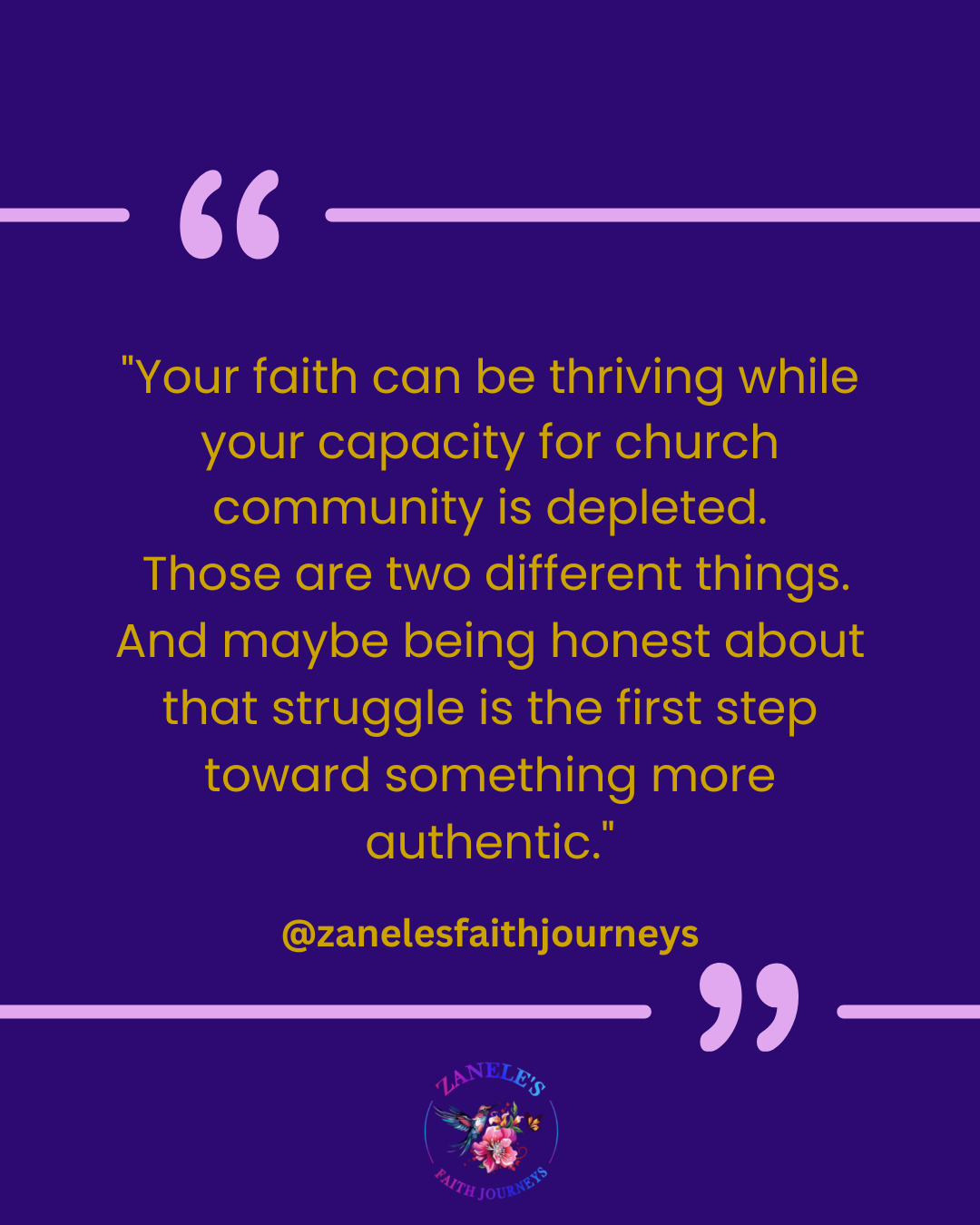
Your faith can be thriving while your capacity for the church community is depleted. Those are two different things. And maybe—just maybe—being honest about that struggle is the first step toward something more authentic, something more real, something that looks less like performance and more like the body of Christ actually loving each other well.
Journal Question: If you could have an honest conversation with God about your struggle with the church, what would you say to Him?
Part 2 is coming on March 4th. You won’t want to miss it.
Life is a faith journey. Walk boldly—even when it’s complicated.
Be brave enough to tell the truth. 💜
Be faithful enough to trust the process. 💜
Be kind enough to extend grace to others and to yourself. 💜